In 2026, Belgian SMEs that fail to automate their marketing are losing ground to more agile competitors. Yet marketing automation is still perceived as a luxury reserved for large companies with substantial budgets and dedicated teams. The reality is quite different: tools have become democratised, costs have plummeted, and results are measurable from the very first weeks. Whether you are a micro-business of five people in Namur or an SME with forty employees in Ghent, automating repetitive marketing tasks frees up time for what truly matters — customer relationships and strategy. This guide shows you concretely where to begin, which use cases to prioritise, and how to avoid common pitfalls.
What is marketing automation for an SME?
Marketing automation refers to all the technologies and processes that allow you to automate repetitive marketing actions: sending emails, segmenting contacts, posting on social media, tracking leads or generating reports. For an SME, the goal is not to replace people, but to eliminate low-value tasks that consume a disproportionate amount of time.
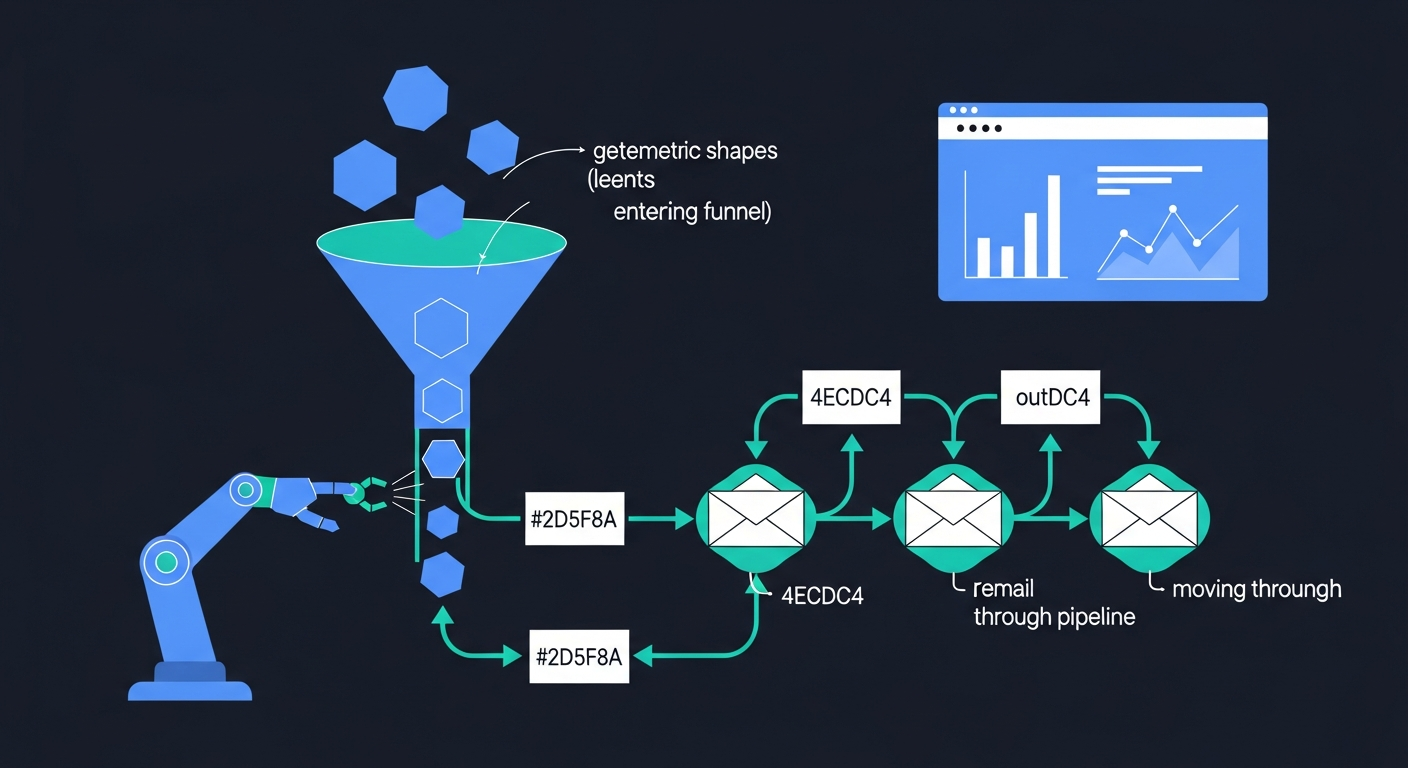
In practice, a marketing automation system rests on three fundamental pillars. The first is data collection: forms, website behaviour, email interactions, purchase history. The second is segmentation: grouping contacts according to relevant criteria (sector, size, stage in the buying journey, engagement level). The third is automatic triggering: when a contact meets a defined condition, an action fires without manual intervention — an email, an internal notification, a status change in the CRM.
The difference between a standard emailing tool and a true marketing automation solution lies in this conditional intelligence. It is no longer about sending a newsletter to your entire database, but about triggering the right message, at the right time, for the right person. In 2026, modern platforms also integrate artificial intelligence capabilities to optimise send times, dynamically personalise content and predict purchasing behaviour.
For a typical Belgian SME, marketing automation translates into an estimated time saving of between 6 and 15 hours per week, depending on the company’s digital maturity and the number of workflows deployed. This is not marginal — it is the equivalent of a half-time role devoted to tasks that a machine executes better and more consistently than a human.
The 5 most profitable use cases
Not all use cases deliver the same return on investment. Here are the five scenarios that generate the most value for Belgian SMEs, ranked by decreasing business impact.
1. Email lead nurturing
Nurturing involves guiding a prospect from their first interaction through to the purchase decision, via a sequence of automated emails. Each message delivers value — a guide, a case study, a client testimonial — and moves the contact closer to conversion. The trigger might be downloading a white paper, registering for a webinar, or a quote request that went unanswered.
A typical workflow for a Belgian B2B SME comprises between 5 and 8 emails spaced 3 to 7 days apart. The first email thanks the contact and delivers the promised resource. Subsequent emails position the company’s expertise, address common objections and propose a call or demonstration. The average conversion rate of a well-constructed nurturing sequence sits between 15% and 25%, compared with 2% to 5% for a standalone one-off email.
The most common mistake is creating sequences that are too long or too sales-heavy. The prospect needs to feel they are receiving value, not being sold to at every interaction. A good rule: 80% educational content, 20% commercial content.
2. Abandoned cart recovery
This use case primarily concerns SMEs with e-commerce activity or an online ordering process. On average, 70% of carts are abandoned before completion. A simple reminder email sent within the hour following abandonment recovers between 10% and 15% of those lost sales.
The optimal workflow comprises three emails: a gentle reminder after one hour (cart contents recap), a reassurance email after 24 hours (customer reviews, guarantees, FAQ), and an incentive offer after 72 hours (free delivery or a time-limited discount). The integration between the e-commerce platform (WooCommerce, Shopify, Odoo) and the marketing automation tool is essential for this workflow to function in real time.
For Belgian SMEs operating in B2B, the equivalent of the abandoned cart is the unfinalised quote. The same principle applies: an automatic reminder after 48 hours, followed by an email providing a reassurance element (similar case study, testimonial), then a call automatically scheduled in the sales representative’s diary.
— /wp:paragraph –>3. Automated client onboarding
Onboarding is the critical moment when a new client discovers your product or service. A botched onboarding triples the risk of churn within the first 90 days. Automating this phase ensures that every client receives the right information at the right time, regardless of your team’s workload.
A typical onboarding workflow for an SaaS or services SME includes: an immediate welcome email with access details and first steps, a getting-started guide after 24 hours, an automated check-in after one week to verify progress, and an invitation to a follow-up call after 14 days. Each step can be conditional on the client’s behaviour — if the client has already completed the setup, the reminder email is automatically suppressed.
The measurable benefit is twofold: a reduction in time spent by your team on repetitive onboarding tasks (up to 60% savings) and improved client retention. Companies that automate their onboarding see an average 25% increase in client satisfaction within the first three months.
4. Lead scoring
Lead scoring assigns a numerical score to each contact based on their characteristics (demographic data, sector, company size) and their behaviour (pages visited, emails opened, forms completed, time spent on site). When a lead reaches a predefined threshold, it is automatically passed to the sales team as “qualified”.
For an SME, scoring avoids two major pitfalls: overloading sales reps with cold leads who are not ready to buy, and letting hot leads slip through because nobody identified them in time. A simple but effective scoring model can be set up in a few days: +10 points for visiting the pricing page, +5 for opening an email, +20 for a demo request, -5 for each week of inactivity.
In 2026, the most advanced tools incorporate AI-based predictive scoring that analyses historical conversion patterns to identify the leads most likely to buy. But even basic rule-based scoring delivers considerable value to an SME processing more than 50 leads per month.
5. Automated marketing reporting
This last use case is often underestimated, yet its impact on decision-making is significant. How many SMEs spend hours each week manually compiling data from Google Analytics, their CRM, their emailing tool and their social media to produce a marketing dashboard? Automating this process eliminates those wasted hours and guarantees reliable, real-time data.
An automated reporting workflow collects data from each source (API or native connectors), consolidates it into a unified format, calculates key KPIs (cost per lead, conversion rate by channel, ROI per campaign) and distributes the report by email every Monday morning. The business owner or marketing manager thus has a complete view without effort, which accelerates budget decisions and campaign optimisation.
Orchestration tools like n8n allow you to connect any data source via API and generate customised reports incorporating AI analysis — automatically detected trends, flagged anomalies, optimisation recommendations. This is a significant competitive advantage for SMEs that want to manage their marketing with the same rigour as large enterprises.
Which tool to choose for a Belgian SME?
The marketing automation market features dozens of solutions, but not all are suited to the realities of Belgian SMEs: limited budget, need for support in French or Dutch, European GDPR compliance, and integration with existing tools (Odoo, WooCommerce, Exact Online, etc.).
Three categories of tools stand out in 2026. All-in-one platforms such as HubSpot, ActiveCampaign or Brevo (formerly Sendinblue) offer CRM, emailing, landing pages and automation in a single interface. They suit SMEs that are just starting out and want a turnkey solution. Prices start between 20 and 50 euros per month for basic plans, but escalate quickly with contact numbers and advanced features.
Orchestration platforms such as n8n, Make.com or Zapier allow you to connect existing tools via visual workflows. They are ideal for SMEs that already have a CRM (Odoo, Salesforce, Dynamics) and a separate emailing tool, and want to automate flows between these systems without migrating everything. n8n, in particular, offers the advantage of being self-hostable — a critical point for businesses concerned about data sovereignty.
Finally, integrated ERP solutions such as Odoo Marketing Automation allow you to automate directly from the management system. The major advantage is native access to commercial, accounting and logistics data — no external synchronisation needed. For a Belgian SME already running Odoo, it is often the most logical starting point before adding an orchestrator.
The main selection criterion should not be the number of features, but the tool’s ability to integrate with your existing stack. A sophisticated tool operating in a silo delivers less value than a simple tool perfectly connected to your CRM, website and invoicing system.
Marketing automation and GDPR: the Belgian rules
The GDPR (General Data Protection Regulation) applies fully to marketing automation, and Belgium adds its own specificities via the Data Protection Authority (DPA). Ignoring these rules exposes the SME to fines of up to 4% of annual global turnover — a risk that even small businesses cannot afford.
Explicit consent is the foundation of any compliant marketing automation strategy. Each contact must have given their agreement in a clear, free and informed manner before receiving commercial communications. Double opt-in (email confirmation after sign-up) is strongly recommended by the Belgian DPA, even if not technically mandatory. It constitutes far more solid proof of consent in the event of an audit.
Processing transparency is the second pillar. Your privacy policy must clearly explain what data is collected, for what purpose, how it is processed, and by which sub-processors. If you use a marketing automation tool hosted outside the EU (the case for many American platforms), you must ensure that Standard Contractual Clauses (SCCs) or an adequate transfer mechanism are in place.
The right to object and unsubscribe must be facilitated in every communication. A clear and functional unsubscribe link is mandatory in every marketing email. The request must be processed immediately — no 30-day delay for an unsubscription. Moreover, the right to erasure (right to be forgotten) obliges the business to delete all of a contact’s data on simple request, including within marketing automation systems.
In practice, here are the actions to implement from the outset: configure double opt-in on all forms, document each processing operation in a register (legal obligation), verify sub-processing agreements (DPA) with each tool provider, train the team on best practices, and plan a notification procedure in the event of a data breach (72 hours maximum to notify the DPA). Specialist support is strongly recommended for SMEs just starting out — the cost is negligible compared with the risk of a sanction.
How to measure marketing automation ROI
Investing in marketing automation without measuring return on investment is like navigating without a compass. Yet many SMEs settle for vanity metrics (open rates, subscriber numbers) instead of measuring the real impact on revenue.
The cost per lead (CPL) is the first indicator to track. It is calculated by dividing total marketing investment (tools + time spent + advertising budget) by the number of leads generated over a given period. Marketing automation typically reduces CPL by 30% to 50% by eliminating manual qualification and follow-up tasks.
The lead-to-client conversion rate measures the effectiveness of your entire funnel. Before automation, a typical Belgian SME converts between 2% and 5% of its leads into clients. With a nurturing and scoring system in place, this rate regularly climbs to between 8% and 15%. The difference translates directly into additional revenue, with no increase in acquisition budget.
Time saved by the team is an often-overlooked but considerable ROI. Quantify the weekly time spent on manual tasks before automation (sending emails, updating the CRM, compiling reports, follow-ups), multiply by the loaded hourly cost, and you have the direct monthly saving. For an SME of 20 people, this saving typically sits between 1,500 and 4,000 euros per month.
Customer Lifetime Value (CLV) completes the picture. Automated onboarding and loyalty sequences increase the average client lifespan and the total value of the relationship. A 10% increase in CLV has a far greater impact than a 10% increase in new client numbers, as it requires no additional acquisition cost.
In summary, the marketing automation ROI formula is: (additional revenue + time savings + CLV increase) – (tool cost + implementation cost + maintenance cost). For the majority of Belgian SMEs, the break-even point is reached between the second and fourth month after deployment.
The Agile Minds approach
At Agile Minds, we support Belgian SMEs in their marketing transformation from our base in Wallonia. Our approach rests on a simple principle: start small, measure fast, and iterate. No six-month mammoth project — we deploy your first marketing automation workflow in 2 to 4 weeks, with measurable results from the first month.
Our technical stack is designed for SMEs: Odoo as the central CRM and ERP, n8n as the workflow orchestrator (self-hosted on our European servers to guarantee GDPR compliance), and native integrations with the tools you already use. Our Autom8 by Agile Minds platform goes further still by providing specialised AI agents that automate not only execution, but also analysis and optimisation of your marketing campaigns.
We work in three phases. The first is audit and mapping: we analyse your current marketing processes, identify quick wins and establish a roadmap prioritised by business impact. The second is progressive deployment: we implement workflows one by one, starting with the one that has the best effort-to-result ratio. The third is continuous optimisation: each month, we analyse performance, adjust workflows and deploy new scenarios.
What sets us apart is our ability to integrate marketing automation within a global digital transformation vision. We do not stop at emails — we connect your marketing to your invoicing, customer support, project management and financial reporting. It is this systemic approach that generates the most significant gains for our clients.
Further reading
- Make.com vs n8n vs Autom8: 2026 Comparison
- Claude API for Business: Practical Guide 2026
- Discover our marketing automation services →
Let’s talk about your project
Want to automate your marketing but not sure where to start? We audit your processes and deploy your first workflow in under a month.
Patrick Impens · CEO Agile Minds SRL · agile-minds.be
Marketing automation and AI workflows · Digital transformation for SMEs
Illustrations générées par IA (art. 50(4) AI Act)
Let's talk about your project
Book a meeting →