
Your site grinds to a halt during peak hours, your SSL certificate expires without warning, and your shared hosting provider tells you “that’s normal, you’re sharing the server with 200 other sites”. If that scenario sounds familiar, you are not alone. In 2026, a growing number of Belgian SMEs are making the leap to a managed VPS to regain control of their web infrastructure — without having to recruit a systems administrator. But is it truly the right choice for your business? In this article, we break down the concrete differences between shared hosting and managed VPS, the signals indicating it is time to migrate, and what this means in terms of budget, performance and GDPR compliance.
Shared hosting vs VPS: what is the difference?
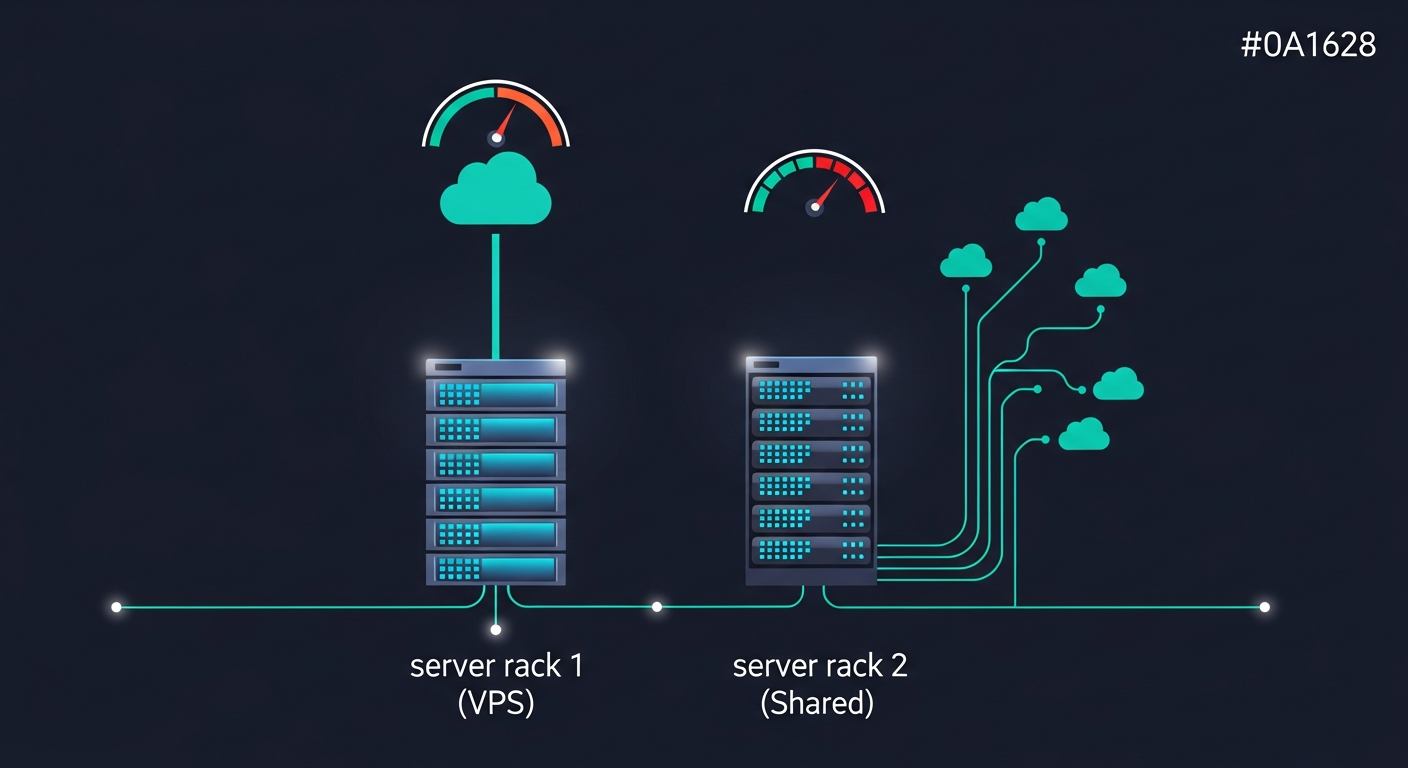
Before comparing the merits of each solution, let us clarify the concepts. Shared hosting involves sharing a single physical server — processor, memory, storage — with dozens, even hundreds of other websites. It is the most economical option: for a few euros per month, you get web space, a database and a control panel. Providers such as OVHcloud, Combell or Infomaniak all offer entry-level shared packages.
A VPS (Virtual Private Server), by contrast, allocates you a dedicated and guaranteed portion of a physical server’s resources. You have your own operating system, your own memory allocation and your own CPU cycles. Nobody else draws on your resources. It is like moving from a noisy coworking space to a private office in the same building.
Add the word “managed” and you get the best of both worlds: the power of a virtual dedicated server, combined with technical management handled by a provider. System updates, 24/7 monitoring, automatic backups, SSL configuration, firewall — everything is taken care of. You focus on your business whilst experts look after your infrastructure.
Here is a comparison table for clarity:
| Criterion | Shared | Unmanaged VPS | Managed VPS |
|---|---|---|---|
| Resources | Shared | Dedicated | Dedicated |
| Performance | Variable | Stable | Stable and optimised |
| Security | Basic | Self-configured | Hardened by experts |
| Technical management | Included (limited) | Entirely your responsibility | Included (comprehensive) |
| Scalability | Limited | Flexible | Flexible + supported |
| Monthly cost | €5-15 | €15-50 | €49-199 |
| Skills required | None | Linux sysadmin | None |
When to move from shared hosting to a VPS?
Shared hosting is not inherently bad. For a 5-page brochure site with 500 visitors per month, it does the job perfectly well. The problem arises when your business grows and your hosting cannot keep up. Here are the warning signs that indicate it is time to migrate to a managed VPS:
- Loading time exceeding 3 seconds. Google considers that beyond this threshold, more than half of mobile visitors leave your site. On an overloaded shared host, you have no lever to improve the situation.
- Unpredictable traffic spikes. You launch a LinkedIn campaign, an article goes viral, or your e-commerce shop experiences a seasonal rush. On shared hosting, these spikes cause slowdowns or even 503 errors.
- Resource-intensive web applications. You are deploying an ERP such as Odoo, an automation tool like n8n, or a bespoke business application. These require guaranteed resources and root access to the server.
- Heightened security requirements. You process sensitive data (customer, payment, medical) and your sector imposes strict standards. The isolation of a VPS is then essential.
- Need for specific configurations. You need to install particular PHP modules, set up a reverse proxy, or configure wildcard SSL certificates. The shared hosting control panel simply does not allow it.
- Multiple sites or applications. You manage several websites, a blog, an online shop and an intranet. Centralising everything on a managed VPS often costs less than multiplying shared hosting plans.
If you tick two or three of these boxes, migrating to a managed VPS is no longer a luxury — it is a worthwhile investment. And contrary to popular belief, this transition can be carried out smoothly, with no service interruption, when orchestrated by an experienced provider.
The advantages of a managed VPS for an SME
Let us turn to the concrete benefits. Why are a growing number of Belgian, Luxembourg and French SMEs choosing a managed VPS in 2026?
Performance and scalability
On a managed VPS, your resources are guaranteed and exclusive. Whether your server neighbour suffers a DDoS attack or experiences a traffic spike, your site continues to function normally. NVMe SSD discs offer access times up to ten times faster than traditional discs, and dedicated RAM allows your applications to run without latency.
Scalability is another major asset. Need more RAM before Black Friday? Your provider adjusts the resources within hours, with no migration or interruption. Business slows down in summer? You can scale back and adjust your costs accordingly. This elasticity is impossible on standard shared hosting.
Security and isolation
Security is probably the most underestimated argument in favour of managed VPS. On shared hosting, a vulnerability in another user’s site can potentially compromise your own installation. This is the infamous “bad neighbour” effect.
A professional managed VPS typically includes:
- A configured firewall with rules tailored to your application stack
- Automatic security updates for the operating system and critical dependencies
- An intrusion detection system (IDS) that alerts in real time
- Automated daily backups with configurable retention
- SSL/TLS certificates automatically renewed via Let’s Encrypt
- Complete isolation between your environment and other clients on the physical server
For an SME processing customer data or online transactions, this layer of security is not optional — it is essential.
Full control without server skills
This is the paradox resolved by managed VPS: you benefit from the power and flexibility of a dedicated server without needing to master Linux, Nginx, Docker or the intricacies of network configuration. Your provider manages the technical infrastructure whilst you retain strategic control.
In practice, this means you can request the installation of a new tool, the configuration of a subdomain, or the optimisation of your database — and it is done by professionals, following best practice. You do not need to search for tutorials on Stack Overflow at 11pm on a Sunday evening when your site goes down.
How much does a managed VPS cost in Belgium?
Let us talk figures. The cost of a managed VPS varies considerably depending on allocated resources, support level and included services. In Belgium and francophone Europe, here are the price ranges you can expect in 2026:
| Plan | Target | Typical resources | Indicative price |
|---|---|---|---|
| Essential | Micro-business, brochure site, blog | 2 vCPU, 4 GB RAM, 80 GB SSD | from €49/month |
| Business | SME, e-commerce, multi-site | 4 vCPU, 8-16 GB RAM, 160 GB SSD | from €99/month |
| Enterprise | Demanding SMEs, ERP, SaaS | 8+ vCPU, 16-32 GB RAM, 320 GB+ SSD NVMe | from €199/month |
These prices typically include comprehensive server management: monitoring, updates, backups, technical support and initial configuration. Compare this with the true cost of “cheap” shared hosting: €10/month for hosting, but how many hours lost in troubleshooting, in excessive loading times that drive away visitors, or in emergency interventions when the site goes down?
For an SME that generates revenue through its website, the return on investment of a managed VPS is measured in weeks, not months. A faster site converts better. A more secure site inspires confidence. A site that is always available never loses sales.
Managed VPS and GDPR: hosting in Europe
Since GDPR came into force in 2018 — and its continuous strengthening by the Belgian Data Protection Authority — the question of data location has become unavoidable for SMEs. Hosting your European customers’ data on servers located in Europe is no longer merely best practice: it is often an obligation.
A managed VPS with a European hosting provider such as OVHcloud offers you several compliance guarantees:
- Data located in Europe. OVHcloud data centres are situated in France (Gravelines, Strasbourg, Roubaix), Germany and other EU countries. Your data never crosses the Atlantic.
- Data sovereignty. Unlike American hyperscalers subject to the Cloud Act, OVHcloud is a French company subject to European law. No foreign authority can demand access to your data without going through European legal procedures.
- Encryption and backups. A serious provider encrypts your data at rest and in transit, and stores your backups in separate data centres — always in Europe.
- Documentation and traceability. Your provider must be able to supply a DPA (Data Processing Agreement) compliant with Article 28 of the GDPR, along with clear documentation on the technical and organisational measures in place.
By choosing a managed VPS hosted in Europe, you transform the GDPR constraint into a competitive advantage. You can proudly display “Data hosted in Europe” on your site — a compelling argument for clients concerned about the protection of their personal information.
Our hosting stack at Agile Minds
At Agile Minds, we do not merely recommend managed VPS — we use it ourselves daily for our own services and those of our clients. Our infrastructure is built on a proven, modern stack, designed for performance, security and maintainability:
- Provider: OVHcloud, Gravelines data centre (Hauts-de-France) — one of the largest data centre campuses in Europe
- Operating system: Debian 12 (Bookworm), renowned for its stability and security
- Server resources: 8 vCPU, 22 GB RAM, NVMe SSD storage — enough to run several demanding applications simultaneously
- Reverse proxy: Traefik v3, which automatically manages HTTPS routing, load balancing and SSL certificate renewal via Let’s Encrypt
- Containerisation: Docker to isolate each application in its own environment, facilitating updates and deployments
- Monitoring: proactive monitoring of resources, response times and availability
- Backups: automated OVHcloud snapshots + scheduled database backups
This architecture allows us to host on a single server WordPress sites, n8n automation instances, business applications and internal tools — all with response times under 200 ms and uptime exceeding 99.9%.
This is precisely the expertise we make available to our clients through our three managed hosting plans: Essential (€49/month), Business (€99/month) and Enterprise (€199/month).
The Agile Minds approach
Migrating to a managed VPS is not simply about “changing host”. It is an opportunity to rethink your web infrastructure as a whole. At Agile Minds, every migration follows a structured process:
- Audit of the existing setup. We analyse your current hosting, your applications, your traffic volumes and your specific needs to recommend the right plan.
- Bespoke architecture. We design the server architecture according to your stack: WordPress, Odoo, WooCommerce, Node.js applications, automation tools, etc.
- Zero-downtime migration. We carry out the migration in the background, test everything on the new server, then switch the DNS once everything is validated. Result: zero downtime.
- Post-migration optimisation. Server cache, compression, CDN, database optimisation — we fine-tune every parameter for optimal performance.
- Ongoing support. Proactive monitoring, regular updates, responsive support. We do not disappear after go-live.
Our philosophy is simple: your web infrastructure should be a growth accelerator, not a brake. Whether you are a micro-business outgrowing its shared hosting or an SME preparing to deploy an ERP, we have the plan and the expertise to support you.
Further reading
- Installing Self-Hosted n8n on a VPS: The Complete Guide
- Odoo Migration: From Cloud to Your Own VPS
- Our managed web hosting plans
Ready to move to managed VPS? Contact our team for a free audit of your current hosting. We will recommend the solution best suited to your business and budget — no jargon, no commitment.
Patrick Impens — CEO & founder of Agile Minds, IT consultancy and Odoo integration in Belgium. We help SMEs transform their digital infrastructure into a growth lever: ERP, AI automation, managed hosting and digital strategy.
Illustrations générées par IA (art. 50(4) AI Act)
Let's talk about your project
Book a meeting →