
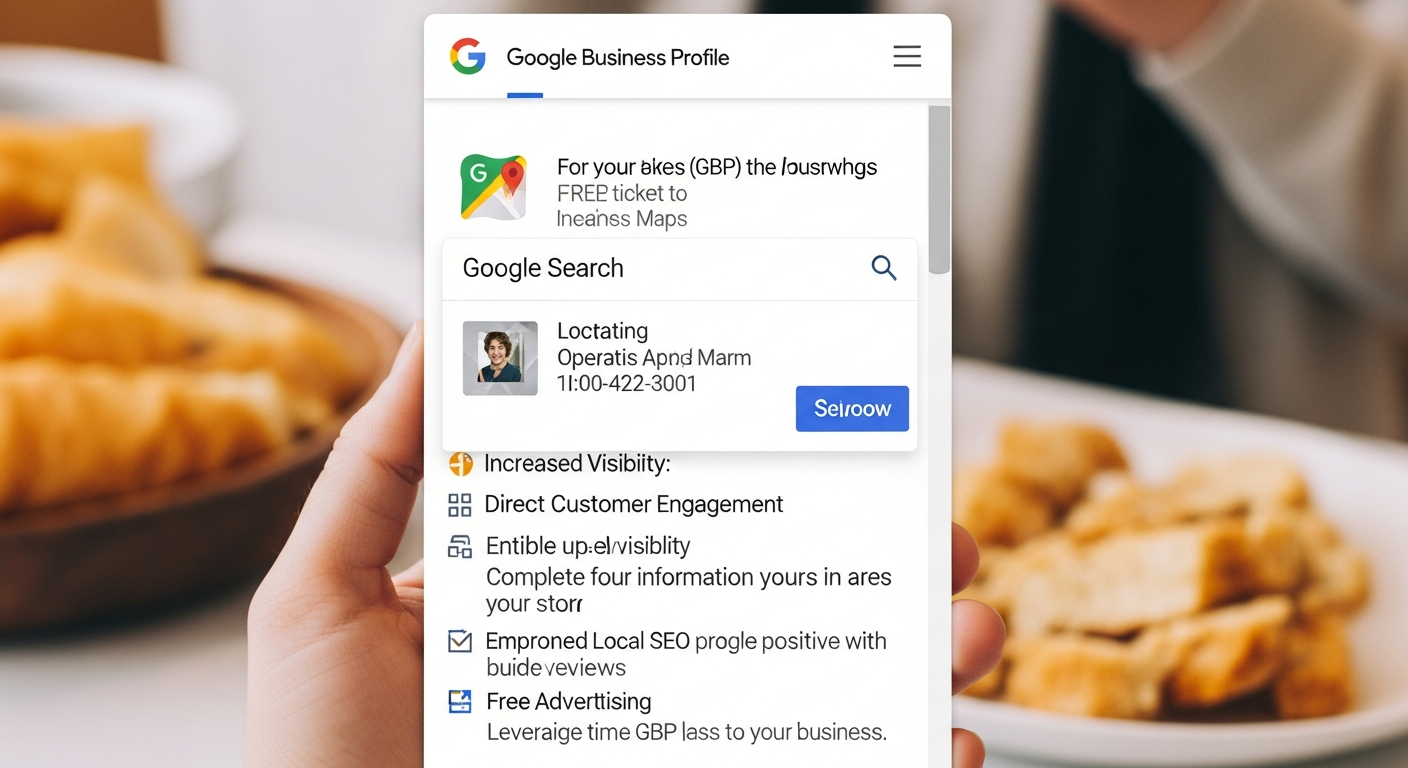
In 2026, 46% of Google searches have a local intent. For a Belgian SME, this means that one in every two potential customers is looking for a product or service near them. Your Google Business Profile (formerly Google My Business) is often the very first point of contact between your business and that prospect. A poorly filled-in listing, unanswered reviews or outdated information are enough to send the customer to your competitor. This comprehensive guide shows you how to transform your GBP listing into a genuine machine for generating qualified contacts, step by step.
Why Google Business Profile is essential for Belgian SMEs
Google Business Profile is not simply an online directory. It is a free local conversion tool that directly influences your revenue. When a user searches for “plumber Namur” or “accountant Liege”, Google first displays the Local Pack: those three highlighted listings on Google Maps, ahead of traditional organic results.
For a Belgian SME, the stakes are multiple. The Belgian market is trilingual and fragmented between Wallonia, Flanders and Brussels. A self-employed professional in Hannut does not target the same audience as a shop in Ghent. Google Business Profile allows you to geographically target your catchment area, display your opening hours adapted to Belgian public holidays (Whit Monday, Community Day, etc.) and communicate in your customer’s language.
The figures speak for themselves. A complete and optimised GBP listing receives on average 7 times more clicks than an incomplete one. Businesses that systematically respond to their reviews see their conversion rate increase significantly. And all of this without spending a single cent on advertising.
Another often-underestimated advantage: Google Business Profile directly feeds Google Maps, local Google Shopping and voice assistants. When a user asks “OK Google, find an Italian restaurant near me”, it is your GBP listing that is consulted. Failing to optimise it means giving up a major acquisition channel.
Creating and optimising your listing in 7 steps
Here is the complete method for creating and optimising your Google Business Profile in Belgium. Each step has a direct impact on your local visibility.
1. Create your listing
Go to business.google.com and sign in with your professional Google account. If your business already exists in Google’s database (which is common for businesses registered with the CBE), you can claim it. Otherwise, create it from scratch.
Key points for Belgian SMEs:
- Business name: use your exact company name as registered with the CBE. No added keywords (“Martin Bakery – Best Artisan Bread Brussels” is prohibited by Google’s guidelines).
- Address: be precise. In Belgium, do not forget the 4-digit postal code and the official municipality (not the village name if it differs).
- Verification: Google typically sends a code by post to your Belgian address. Allow 5 to 14 working days. Video or telephone verification is sometimes offered depending on the type of business.
- VAT number: whilst not mandatory in GBP, displaying your CBE or VAT number in the description reinforces trust.
2. Choose the right categories
The primary category is the single most important ranking factor in the Local Pack. Google offers over 4,000 categories. Choose the one that best describes your core activity.
Practical tips:
- Use a tool such as PlePer or GMB Everywhere to analyse the categories used by your local competitors.
- Add up to 9 relevant secondary categories. A garage can add “Tyre repair”, “MOT testing centre” and “Used car dealer”.
- Review your categories every quarter: Google regularly adds new options.
For a Belgian multi-service SME (common in our economic fabric), prioritise: the primary category should match your main revenue source.
3. Optimise the description
You have 750 characters to convince. This text appears directly on your listing and influences local ranking. Here is the recommended structure:
- Opening line (1-2 lines): who are you and what problem do you solve?
- Main services (2-3 lines): list your key offerings with natural keywords.
- Geographical area (1 line): mention the municipalities and provinces you cover.
- Differentiator (1 line): certification, years of experience, specialisation.
Naturally integrate your local keywords: “Belgian SME”, your municipality name, your province. Avoid keyword stuffing, which is penalised by Google. Write for the human first, for the algorithm second.
4. Add professional photos
Listings with photos receive 42% more direction requests and 35% more clicks to the website. This is not a cosmetic detail — it is a measurable conversion lever.
Minimum photo programme for a Belgian SME:
- Cover photo: your shopfront or team in action (1 photo, updated annually).
- Logo: square format, transparent or neutral background.
- Interior: 3 to 5 photos showing the ambiance of your premises.
- Exterior: 2 to 3 photos of your building from different angles, in summer and winter.
- Team: 2 to 3 photos of your staff at work.
- Products/services: 5 to 10 photos of your work, flagship products or completed projects.
Technical specifications: JPEG or PNG, between 10 KB and 5 MB, minimum resolution of 720 x 720 pixels. Geolocate your photos (EXIF metadata helps Google confirm your location). Add new photos at least once a month to signal to Google that your listing is active.
5. Manage customer reviews
Google reviews are the second most important local ranking factor after category. They influence both your position in the Local Pack and the prospect’s purchasing decision.
Review strategy for Belgian SMEs:
- Ask systematically: after every successful service, send a direct link to your Google review form. Create this link in the GBP dashboard (“Ask for reviews” section).
- Respond to all reviews: positive and negative alike, within 24 to 48 hours. For negative reviews, remain professional and offer a private resolution.
- Personalise your responses: generic replies (“Thank you for your review”) add no value. Mention the client’s first name and the service concerned.
- Never purchase reviews: Google detects and penalises fake reviews. In Belgium, this practice can also be sanctioned by the FPS Economy as an unfair commercial practice.
Realistic target for a local SME: aim for a minimum of 5 new reviews per month with an average rating above 4.2/5.
6. Publish regular Google Posts
Google Posts are short publications (1,500 characters max) that appear directly on your listing. They are your free mini-blog on Google. Three types of posts are available:
- Updates: new services, hours changes, events. Lifespan of 7 days.
- Offers: promotions with start and end dates. Ideal for Belgian sales periods or year-end holidays.
- Events: open days, training sessions, workshops. Visible until the event date.
Recommended frequency: 1 to 2 posts per week. Each post should contain an attractive image (4:3 ratio, 400 x 300 px minimum), concise text with a call to action (CTA) and a link to your site. Vary the topics: practical tip, client testimonial, behind-the-scenes of your trade, industry news.
Belgian tip: publish posts adapted to the local calendar. Back-to-school season in September, local community festivals, the Batibouw trade fair, Saint Nicholas… these moments generate spikes in local searches.
7. Configure attributes and services
Google offers specific attributes that customers use to filter their searches. Do not neglect this section:
- Objective attributes: wheelchair accessible, free parking, Wi-Fi, card payment, terrace…
- Subjective attributes: “popular with families”, “cosy atmosphere” (generated by customer reviews).
- Services: list each of your services with a short description. This allows Google to display you for more precise queries.
- Products: if you sell products, create a catalogue with photos, prices and descriptions.
For bilingual or trilingual Belgian businesses, remember to configure your services in your clients’ languages. A Brussels-based shop should ideally cover both French and Dutch.
Google Business Profile and Belgian local SEO
Belgian local SEO has specificities that your GBP strategy must take into account. The Belgian market is compact yet fragmented: three regions, three linguistic communities, 581 municipalities. This fragmentation is in reality an opportunity for local SMEs.
The three pillars of local SEO in Belgium:
- Relevance: your GBP listing must match the search precisely. Categories, description, services and attributes play a central role here.
- Distance: Google favours businesses close to the user. Your physical address is determining.
- Prominence: number of reviews, average rating, consistent NAP (Name, Address, Phone) citations across the web, local backlinks.
Essential Belgian NAP citations: ensure your name, address and phone number are identical on your GBP listing, your website, Golden Pages (goldenpages.be), Yelp, Trustpilot, your municipality’s website and relevant Belgian sector directories. Any inconsistency (different abbreviation, old phone number) weakens your local ranking.
Multilingual strategy: if your catchment area spans multiple linguistic regions (typical for Brussels businesses or those near the language border), consider creating localised landing pages on your website in French and Dutch, and varying the language of your Google Posts.
Common mistakes to avoid
After hundreds of GBP audits conducted for Belgian SMEs, here are the most frequent and costly mistakes:
- Listing claimed but never updated: outdated opening hours (especially during Belgian school holidays) drive customers away and generate negative reviews.
- Keyword stuffing in the name: adding “best”, “cheap” or city names to your business name violates Google’s guidelines. Penalty: listing suspension.
- Ignoring negative reviews: an unanswered negative review causes more damage than the review itself. Prospects read your responses as much as the reviews.
- Poor-quality photos: blurry, dark or generic photos (stock images) are counterproductive. Invest in a professional photo shoot.
- Overly vague or incorrect categories: “Business” instead of “IT Consultant” drastically reduces your visibility.
- Virtual address or PO box: Google detects and penalises non-physical addresses. If you are self-employed without an office, use the “service area” option without displaying an address.
- Duplicate listings: common after a move or change of company name. Search for and remove obsolete listings.
- Not using GBP insights: the dashboard provides valuable data on the queries leading to your listing, user actions and comparison with competitors. Analyse these metrics monthly.
GBP and AI: how generative engines use your listing
In 2026, artificial intelligence is profoundly transforming local search. Google SGE (Search Generative Experience), AI Overviews and conversational assistants (Gemini, ChatGPT with browsing, Claude) are changing the way consumers find and choose a local business.
What this changes for your GBP listing:
- Generative answers cite GBP listings: when a user asks an AI engine “what is the best electrician in Namur?”, the AI compiles information from GBP listings, Google reviews, websites and directories. Your complete listing and positive reviews directly feed these answers.
- Content quality takes precedence over quantity: generative engines analyse the meaning of your descriptions, not just keywords. Write natural, informative and specific texts rather than keyword lists.
- Reviews become source content: AI engines extract verbatim quotes from customer reviews to build their responses. A detailed review mentioning “fast service for repairing my Vaillant boiler in Liege” has more value than a simple “Great, thanks!”.
- Structured data count double: the attributes, services, products and FAQs in your GBP listing constitute structured data that AI engines consume directly. The more complete your listing, the more likely it is to feed AI responses.
Concrete actions for the AI search era:
- Write a GBP description that naturally answers your clients’ frequently asked questions.
- Encourage detailed reviews (not just star ratings) by asking specific questions after each service.
- Update your services and attributes monthly to reflect your current offering.
- Publish regular Google Posts with informative, useful content.
- Ensure consistency between your GBP listing, your website and your directory profiles. AI engines cross-reference sources to verify information reliability.
The trend is clear: SMEs whose GBP listing is complete, up to date and rich in content will be those that appear in AI engine answers, whether via Google SGE, a voice assistant or a conversational chatbot.
The Agile Minds approach
At Agile Minds, we support Belgian SMEs in their local visibility strategy from GBP listing creation through to ongoing optimisation. Our approach combines local SEO expertise, intelligent automation and performance monitoring.
Our 4-phase method:
- Initial audit: analysis of your current listing, local competitive benchmarking, identification of ranking opportunities within your geographical area.
- Complete optimisation: configuration of all GBP fields, SEO description copywriting, professional photo shoot, implementation of the review strategy.
- Automation: using our n8n workflows and AI agents, we automate Google Post publication, review monitoring and monthly reporting.
- Monitoring and iteration: monthly analysis of GBP insights, strategy adjustment, monitoring of local algorithm changes.
We integrate Google Business Profile within a comprehensive digital strategy including on-site SEO, content marketing and marketing automation. This holistic approach guarantees sustainable and measurable local visibility.
Further reading
- SEO for Belgian SMEs: The Complete Guide 2026
- Make.com vs n8n vs Autom8: 2026 Comparison
- Our digital marketing services for SMEs →
Let’s talk about your project
Your Google Business Profile deserves better than basic form-filling. Let us discuss your local visibility and the strategy best suited to your Belgian market.
Patrick Impens · CEO Agile Minds SRL · agile-minds.be
Digital marketing and local SEO for SMEs
Our digital transformation services.
Let's talk about your project
Book a meeting →