
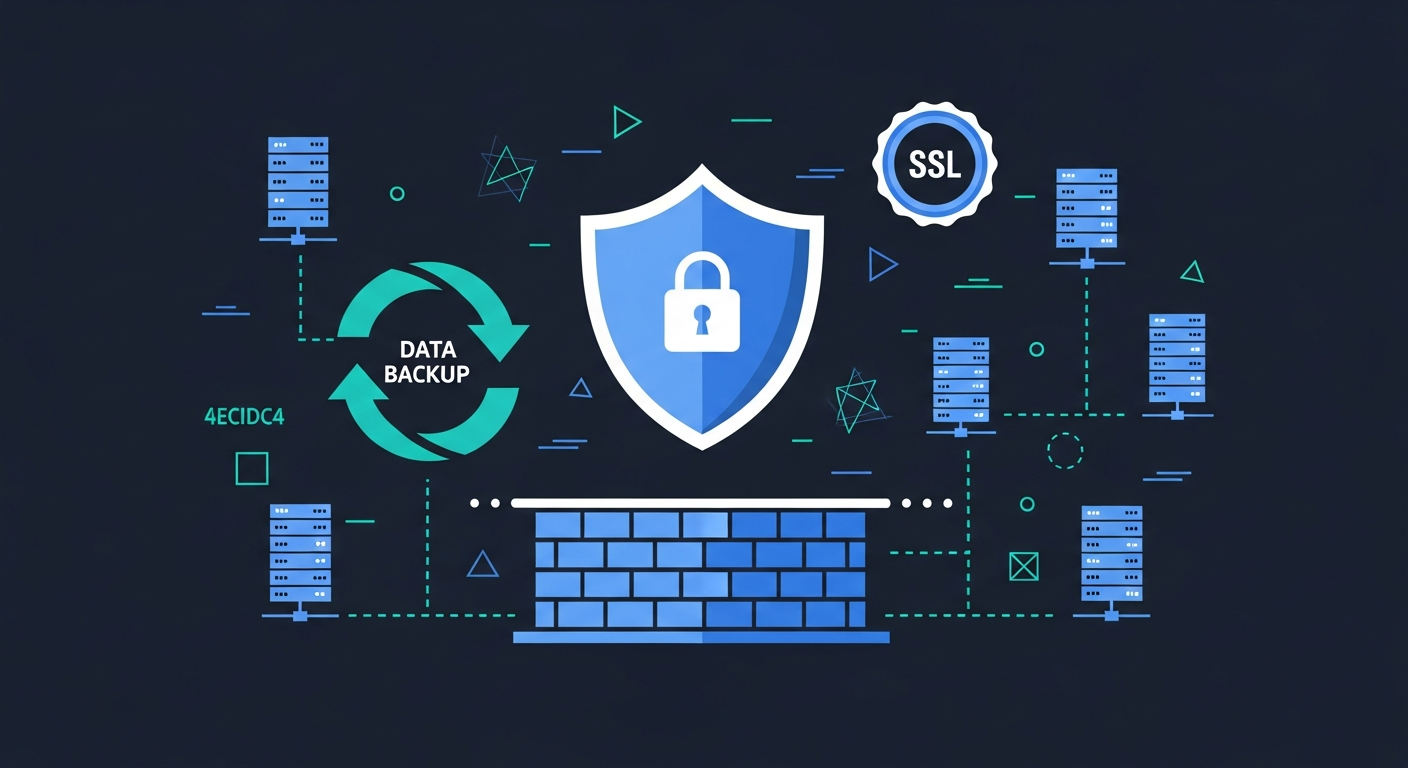
From a GDPR perspective, backups containing personal data must also be protected and subject to the same retention and deletion rules as the source data. This is an often-overlooked point that can create compliance issues.
— /wp:paragraph –>3. Regular updates
Outdated software is one of the most exploited attack vectors. Whether it is the CMS (WordPress, Odoo, Joomla), plugins, server dependencies, the operating system or third-party libraries, every unpatched component represents a documented, exploitable vulnerability.
Attackers use automated scanners that trawl the web searching for sites running versions known to be vulnerable. A published flaw can be exploited at scale within hours. The race between patch publication and application is therefore a major concern.
For an SME, update management must be structured and proactive. This means setting up vulnerability monitoring for your technical stack, scheduling regular maintenance windows (weekly for minor patches, immediate for critical flaws), testing updates in a staging environment before applying them in production, and automating the process as far as possible via CI/CD tools. Updates concern not only application software: the operating system, certificates, security configurations and firewall rules must also be reviewed regularly.
4. Web Application Firewall (WAF)
The Web Application Firewall, or WAF, acts as an intelligent filter between the internet and your web application. Unlike a standard network firewall operating at the port and protocol level, the WAF analyses the content of HTTP requests and blocks those matching known attack patterns.
The most common attacks intercepted by a WAF include SQL injections (aimed at manipulating your database), cross-site scripting (XSS, allowing injection of malicious code into pages viewed by other users), path traversal attempts, brute-force attacks on login forms, and malformed requests designed to trigger exploitable errors.
For an SME, a WAF can be deployed in several ways. Cloud solutions such as Cloudflare or Sucuri offer immediate protection without infrastructure modification. Solutions integrated into the reverse proxy, such as Traefik’s security middlewares combined with custom rules, allow finer-grained control. The essential point is to configure the WAF in monitoring mode during an initial period, to identify false positives before switching to active blocking mode.
5. Strengthened authentication
Authentication is often the weakest link in the security chain. Weak, reused or shared passwords represent the leading cause of account compromises. In 2026, the simple username/password combination is no longer sufficient to protect sensitive access.
Multi-factor authentication (MFA or 2FA) must be enabled on all critical access points: site administration panel, SSH server access, hosting consoles, professional email accounts and SaaS tools. Physical FIDO2/WebAuthn security keys or authenticator apps (TOTP) are preferable to SMS codes, which are more vulnerable to interception.
Beyond MFA, several best practices strengthen authentication posture. Enforcing a robust password policy (minimum 14 characters, complexity) remains fundamental. Limiting login attempts and temporarily locking accounts after multiple failures protects against brute-force attacks. Implementing SSH key-based access rather than password authentication for server connections eliminates a common attack vector. Finally, applying the principle of least privilege ensures that each user has only the rights strictly necessary for their role.
6. Monitoring and alerts
Security is not a fixed state — it is an ongoing process. An effective monitoring system allows you to detect anomalies and intrusion attempts in real time, well before they cause irreversible damage.
Security monitoring for an SME must cover several dimensions. Uptime monitoring continuously checks that your services are accessible and alerts immediately in the event of an outage. Analysis of server and application logs allows you to spot suspicious behaviour: unusual request spikes, repeated access attempts to protected resources, connections from abnormal geolocations. File integrity monitoring detects any unauthorised modification of source code or configuration.
— /wp:paragraph –>Alerts must be configured with discernment: too many alerts create fatigue and lead to them being ignored; too few let real incidents slip through. The ideal is to rank alerts in three tiers: critical (immediate response required), warning (investigation within 24 hours) and informational (weekly review). Tools such as UptimeRobot, Grafana or solutions integrated into your infrastructure allow you to implement this monitoring without excessive complexity.
Web security and GDPR: Belgian obligations
In Belgium, web security and personal data protection are inseparable. GDPR (General Data Protection Regulation) requires businesses to implement appropriate technical and organisational measures to ensure a level of security proportionate to the risk. For SMEs that process personal data via their website — and that is virtually all of them — this translates into concrete obligations.
Article 32 of GDPR explicitly lists encryption and pseudonymisation as security measures. A website collecting data via forms (contact, registration, order) without an SSL certificate is therefore in direct breach. Equally, the absence of backups enabling data restoration in the event of an incident constitutes a failure to guarantee the availability and resilience of processing systems.
The Belgian DPA (Data Protection Authority) has considerably stepped up its auditing and enforcement activity. Fines can reach 4% of annual global turnover or 20 million euros, whichever is higher. Whilst these maximum amounts primarily target large corporations, the DPA has shown it does not hesitate to sanction SMEs for basic failings, notably the absence of a security policy, failure to maintain a processing register, or late notification of a data breach.
In the event of a data breach, the business has 72 hours to notify the DPA, unless the breach is unlikely to result in a risk to individuals’ rights and freedoms. If the risk is high, the individuals concerned must also be informed without undue delay. These very tight deadlines make it imperative to have prepared an incident response plan in advance, including detection, assessment and notification procedures.
Furthermore, GDPR compliance also involves visible elements on the website itself. A clear and complete privacy policy, a compliant cookie consent banner (no pre-ticked boxes, ability to refuse as easily as to accept), up-to-date legal notices and forms collecting only strictly necessary data (principle of data minimisation) are all elements verified during an audit.
The cost of a security breach for an SME
Many SME directors view cybersecurity as a cost centre. In reality, it is an insurance policy whose return on investment is measured in losses avoided. The figures speak for themselves and illustrate the scale of the risks for small and medium-sized businesses.
Direct costs of a breach include technical remediation (site clean-up, data restoration, security hardening), which can run from several thousand to tens of thousands of euros depending on severity. Add potential GDPR fines, legal fees if customer data has been compromised, and the cost of a possible ransom payment in the case of ransomware (though this is strongly discouraged).
Indirect costs are often even more devastating. Lost revenue during site downtime can amount to thousands of euros per day for an e-commerce site. Reputational damage leads to loss of trust from existing clients and difficulty acquiring new ones. Loss of SEO ranking, if Google detects a compromised site and flags it as dangerous, can take months to recover. Finally, crisis management time mobilises the leadership team at the expense of productive activity.
For a Belgian SME, the average total cost of a significant security incident sits between 25,000 and 120,000 euros — an amount that can jeopardise the very survival of the business. By comparison, implementing a professional secure infrastructure represents a monthly investment of a few hundred euros — a cost/benefit ratio that leaves no room for doubt.
Our security approach at Agile Minds
At Agile Minds, security is not an option or a premium add-on: it is built in from the design stage of every hosting and web development project. Our approach rests on a controlled infrastructure, proven processes and permanent monitoring of emerging threats.
Our infrastructure is hosted on OVHcloud VPS servers in a European data centre (Gravelines, France), guaranteeing data sovereignty in compliance with GDPR requirements. The Traefik v3 reverse proxy handles automatic SSL certificate renewal via Let’s Encrypt, TLS 1.3 termination and secure routing of all services. Backups are automated daily with OVHcloud snapshots supplemented by scheduled database exports, stored in encrypted form and tested regularly.
We apply a proactive update policy, with continuous vulnerability monitoring across our entire stack (Debian, Docker, applications). Deployment is carried out via GitHub Actions CI/CD pipelines, ensuring traceability and reproducibility of every change. 24/7 monitoring with graduated alerts enables us to intervene rapidly when anomalies are detected.
For our clients, we offer three tiers of secure hosting — Essential, Business and Enterprise — each including security fundamentals (automatic SSL, backups, updates, monitoring) with increasing levels of service and customisation. The support also includes an initial security audit, GDPR compliance recommendations and responsive incident support.
Web security is an investment, not an expense. And like any investment, it returns far more than it costs — provided it is done seriously, with the right partners.
Take action
Is your website truly secure? Are your backups functional? Is your GDPR compliance up to date? If you have the slightest doubt, it is time to act. Contact our team for a free security audit of your web infrastructure. Together, we will identify vulnerabilities and put in place a security plan tailored to your SME’s reality.
Also discover our other articles on web hosting and security:
- Managed VPS vs Shared Hosting: Which for Your SME in 2026?
- Web Hosting Migration: Zero-Downtime Guide for SMEs
- WordPress vs Odoo for Your SME Website: 2026 Comparison
Agile Minds SRL — IT Consultancy & Digital Transformation — Avin, Wallonia, Belgium
agile-minds.be · patrick@agile-minds.be · VAT BE1026370856
Web Security for SMEs: SSL, Backups and GDPR in 2026
In 2026, web security is no longer a luxury reserved for large enterprises. For Belgian SMEs, a security breach can mean days of downtime, irreversible loss of customer trust and severe financial penalties under GDPR. Yet the majority of small and medium-sized businesses still underestimate the risks associated with their online presence.
According to the Centre for Cybersecurity Belgium (CCB), over 40% of cyberattacks now target SMEs, precisely because they are perceived as soft targets. A website without an SSL certificate, non-existent backups or neglected GDPR compliance represent so many open doors for attackers.
In this article, we review the six essential security measures that every Belgian SME should implement, the legal obligations regarding data protection, and the concrete approach Agile Minds deploys to sustainably secure its clients’ web infrastructures.
Why web security is critical for Belgian SMEs
The digital transformation of Belgian SMEs has accelerated considerably in recent years. Brochure sites, e-commerce, client portals, online business applications: the attack surface continues to expand. Yet this increased exposure is not always accompanied by a corresponding increase in cybersecurity maturity.
Several factors make SMEs particularly vulnerable. Firstly, limited IT budgets often lead to compromises on security. Secondly, the absence of dedicated cybersecurity staff means that best practices are neither known nor applied. Finally, reliance on multiple providers without overall coordination creates blind spots in the protection chain.
The consequences of a successful attack are disproportionate for an SME. Where a large enterprise can absorb the financial and reputational shock, an SME risks simply going out of business. The average downtime following a ransomware attack exceeds 20 days for businesses with fewer than 50 employees — a shutdown that few small companies can afford.
Added to this is the increasingly demanding Belgian and European regulatory framework. GDPR imposes strict obligations on personal data protection, and the Belgian Data Protection Authority (DPA) no longer hesitates to sanction negligent businesses, regardless of their size. The NIS2 directive, now in force, further broadens the scope of companies subject to cybersecurity obligations.
The 6 essential security measures
Securing a website or online infrastructure does not necessarily require colossal investment. It does, however, require method, rigour and a structured approach. Here are the six pillars on which every SME should build its web security strategy.
1. Automatic SSL/TLS certificate
The SSL certificate (or more precisely TLS in its modern version) is the first visible security component of your website. It ensures encryption of exchanges between your visitors’ browser and your server, thus protecting data in transit: contact forms, login credentials, payment information.
In 2026, a site without HTTPS is not only a security risk but also a commercial handicap. Browsers display dissuasive warnings to visitors, Google penalises these sites in its rankings, and users themselves have learnt to check for the padlock in the address bar. For GDPR compliance in Belgium, encryption of data in transit is considered a baseline technical measure under Article 32 of the regulation.
Best practice is to implement automatic certificate renewal via solutions such as Let’s Encrypt integrated into a reverse proxy like Traefik. This mechanism eliminates the risk of forgotten expiry — a frequent cause of service interruption and loss of trust. It is also recommended to configure HSTS (HTTP Strict Transport Security) to systematically force secure connections and to use exclusively TLS 1.3, the most recent and robust version of the protocol.
2. Automated and tested backups
Website backups are the life insurance of your online presence. Without reliable backups, any hardware failure, human error or ransomware attack can result in permanent loss of your data and site.
But beware: having backups is not enough. They must be automated, regular, stored offsite and above all tested. Too many businesses discover at restoration time that their backups are corrupted, incomplete or unusable. It is an unfortunately common and catastrophic scenario.
A robust backup strategy for an SME rests on several principles. The 3-2-1 rule forms the foundation: three copies of your data, on two different media, with one offsite. Backups should be scheduled daily at a minimum, with more frequent snapshots for critical data. Backup encryption is essential, both in storage and in transit. Finally, restoration tests should be carried out periodically, at least once per quarter, to ensure the process actually works when you need it.
From a GDPR perspective, backups containing personal data must also be protected and subject to the same retention and deletion rules as the source data. This is an often-overlooked point that can create compliance issues.
— /wp:paragraph –>3. Regular updates
Outdated software is one of the most exploited attack vectors. Whether it is the CMS (WordPress, Odoo, Joomla), plugins, server dependencies, the operating system or third-party libraries, every unpatched component represents a documented, exploitable vulnerability.
Attackers use automated scanners that trawl the web searching for sites running versions known to be vulnerable. A published flaw can be exploited at scale within hours. The race between patch publication and application is therefore a major concern.
For an SME, update management must be structured and proactive. This means setting up vulnerability monitoring for your technical stack, scheduling regular maintenance windows (weekly for minor patches, immediate for critical flaws), testing updates in a staging environment before applying them in production, and automating the process as far as possible via CI/CD tools. Updates concern not only application software: the operating system, certificates, security configurations and firewall rules must also be reviewed regularly.
4. Web Application Firewall (WAF)
The Web Application Firewall, or WAF, acts as an intelligent filter between the internet and your web application. Unlike a standard network firewall operating at the port and protocol level, the WAF analyses the content of HTTP requests and blocks those matching known attack patterns.
The most common attacks intercepted by a WAF include SQL injections (aimed at manipulating your database), cross-site scripting (XSS, allowing injection of malicious code into pages viewed by other users), path traversal attempts, brute-force attacks on login forms, and malformed requests designed to trigger exploitable errors.
For an SME, a WAF can be deployed in several ways. Cloud solutions such as Cloudflare or Sucuri offer immediate protection without infrastructure modification. Solutions integrated into the reverse proxy, such as Traefik’s security middlewares combined with custom rules, allow finer-grained control. The essential point is to configure the WAF in monitoring mode during an initial period, to identify false positives before switching to active blocking mode.
5. Strengthened authentication
Authentication is often the weakest link in the security chain. Weak, reused or shared passwords represent the leading cause of account compromises. In 2026, the simple username/password combination is no longer sufficient to protect sensitive access.
Multi-factor authentication (MFA or 2FA) must be enabled on all critical access points: site administration panel, SSH server access, hosting consoles, professional email accounts and SaaS tools. Physical FIDO2/WebAuthn security keys or authenticator apps (TOTP) are preferable to SMS codes, which are more vulnerable to interception.
Beyond MFA, several best practices strengthen authentication posture. Enforcing a robust password policy (minimum 14 characters, complexity) remains fundamental. Limiting login attempts and temporarily locking accounts after multiple failures protects against brute-force attacks. Implementing SSH key-based access rather than password authentication for server connections eliminates a common attack vector. Finally, applying the principle of least privilege ensures that each user has only the rights strictly necessary for their role.
6. Monitoring and alerts
Security is not a fixed state — it is an ongoing process. An effective monitoring system allows you to detect anomalies and intrusion attempts in real time, well before they cause irreversible damage.
Security monitoring for an SME must cover several dimensions. Uptime monitoring continuously checks that your services are accessible and alerts immediately in the event of an outage. Analysis of server and application logs allows you to spot suspicious behaviour: unusual request spikes, repeated access attempts to protected resources, connections from abnormal geolocations. File integrity monitoring detects any unauthorised modification of source code or configuration.
— /wp:paragraph –>Alerts must be configured with discernment: too many alerts create fatigue and lead to them being ignored; too few let real incidents slip through. The ideal is to rank alerts in three tiers: critical (immediate response required), warning (investigation within 24 hours) and informational (weekly review). Tools such as UptimeRobot, Grafana or solutions integrated into your infrastructure allow you to implement this monitoring without excessive complexity.
Web security and GDPR: Belgian obligations
In Belgium, web security and personal data protection are inseparable. GDPR (General Data Protection Regulation) requires businesses to implement appropriate technical and organisational measures to ensure a level of security proportionate to the risk. For SMEs that process personal data via their website — and that is virtually all of them — this translates into concrete obligations.
Article 32 of GDPR explicitly lists encryption and pseudonymisation as security measures. A website collecting data via forms (contact, registration, order) without an SSL certificate is therefore in direct breach. Equally, the absence of backups enabling data restoration in the event of an incident constitutes a failure to guarantee the availability and resilience of processing systems.
The Belgian DPA (Data Protection Authority) has considerably stepped up its auditing and enforcement activity. Fines can reach 4% of annual global turnover or 20 million euros, whichever is higher. Whilst these maximum amounts primarily target large corporations, the DPA has shown it does not hesitate to sanction SMEs for basic failings, notably the absence of a security policy, failure to maintain a processing register, or late notification of a data breach.
In the event of a data breach, the business has 72 hours to notify the DPA, unless the breach is unlikely to result in a risk to individuals’ rights and freedoms. If the risk is high, the individuals concerned must also be informed without undue delay. These very tight deadlines make it imperative to have prepared an incident response plan in advance, including detection, assessment and notification procedures.
Furthermore, GDPR compliance also involves visible elements on the website itself. A clear and complete privacy policy, a compliant cookie consent banner (no pre-ticked boxes, ability to refuse as easily as to accept), up-to-date legal notices and forms collecting only strictly necessary data (principle of data minimisation) are all elements verified during an audit.
The cost of a security breach for an SME
Many SME directors view cybersecurity as a cost centre. In reality, it is an insurance policy whose return on investment is measured in losses avoided. The figures speak for themselves and illustrate the scale of the risks for small and medium-sized businesses.
Direct costs of a breach include technical remediation (site clean-up, data restoration, security hardening), which can run from several thousand to tens of thousands of euros depending on severity. Add potential GDPR fines, legal fees if customer data has been compromised, and the cost of a possible ransom payment in the case of ransomware (though this is strongly discouraged).
Indirect costs are often even more devastating. Lost revenue during site downtime can amount to thousands of euros per day for an e-commerce site. Reputational damage leads to loss of trust from existing clients and difficulty acquiring new ones. Loss of SEO ranking, if Google detects a compromised site and flags it as dangerous, can take months to recover. Finally, crisis management time mobilises the leadership team at the expense of productive activity.
For a Belgian SME, the average total cost of a significant security incident sits between 25,000 and 120,000 euros — an amount that can jeopardise the very survival of the business. By comparison, implementing a professional secure infrastructure represents a monthly investment of a few hundred euros — a cost/benefit ratio that leaves no room for doubt.
Our security approach at Agile Minds
At Agile Minds, security is not an option or a premium add-on: it is built in from the design stage of every hosting and web development project. Our approach rests on a controlled infrastructure, proven processes and permanent monitoring of emerging threats.
Our infrastructure is hosted on OVHcloud VPS servers in a European data centre (Gravelines, France), guaranteeing data sovereignty in compliance with GDPR requirements. The Traefik v3 reverse proxy handles automatic SSL certificate renewal via Let’s Encrypt, TLS 1.3 termination and secure routing of all services. Backups are automated daily with OVHcloud snapshots supplemented by scheduled database exports, stored in encrypted form and tested regularly.
We apply a proactive update policy, with continuous vulnerability monitoring across our entire stack (Debian, Docker, applications). Deployment is carried out via GitHub Actions CI/CD pipelines, ensuring traceability and reproducibility of every change. 24/7 monitoring with graduated alerts enables us to intervene rapidly when anomalies are detected.
For our clients, we offer three tiers of secure hosting — Essential, Business and Enterprise — each including security fundamentals (automatic SSL, backups, updates, monitoring) with increasing levels of service and customisation. The support also includes an initial security audit, GDPR compliance recommendations and responsive incident support.
Web security is an investment, not an expense. And like any investment, it returns far more than it costs — provided it is done seriously, with the right partners.
Take action
Is your website truly secure? Are your backups functional? Is your GDPR compliance up to date? If you have the slightest doubt, it is time to act. Contact our team for a free security audit of your web infrastructure. Together, we will identify vulnerabilities and put in place a security plan tailored to your SME’s reality.
Also discover our other articles on web hosting and security:
- Managed VPS vs Shared Hosting: Which for Your SME in 2026?
- Web Hosting Migration: Zero-Downtime Guide for SMEs
- WordPress vs Odoo for Your SME Website: 2026 Comparison
Agile Minds SRL — IT Consultancy & Digital Transformation — Avin, Wallonia, Belgium
agile-minds.be · patrick@agile-minds.be · VAT BE1026370856
Let's talk about your project
Book a meeting →